

What is the hardness of PVC UV board?
Oct 20, 2025
Leave a message
What is the hardness of PVC UV board?
As a supplier of PVC UV boards, I often encounter inquiries from customers about the hardness of these boards. Understanding the hardness of PVC UV boards is crucial for various applications, from interior decoration to industrial uses. In this blog post, I will delve into the concept of hardness in PVC UV boards, its measurement, factors affecting it, and its significance in different scenarios.
Understanding Hardness in PVC UV Boards
Hardness refers to the ability of a material to resist indentation, scratching, or abrasion. In the case of PVC UV boards, hardness plays a vital role in determining their durability and performance. A harder PVC UV board is more likely to withstand wear and tear, making it suitable for high - traffic areas or applications where it may be exposed to physical stress.
The hardness of PVC UV boards is influenced by several factors, including the formulation of the PVC resin, the additives used, and the manufacturing process. PVC (polyvinyl chloride) is a thermoplastic polymer, and its properties can be modified by adding various substances such as plasticizers, stabilizers, and fillers.
Measurement of Hardness
There are several methods to measure the hardness of PVC UV boards. One of the most commonly used methods is the Shore hardness test. The Shore hardness scale measures the resistance of a material to indentation using a durometer. There are different types of durometers, such as Shore A and Shore D. Shore A is typically used for softer materials, while Shore D is used for harder plastics.
For PVC UV boards, the Shore D scale is often more appropriate as these boards are relatively hard compared to some other PVC products. A higher Shore D value indicates a harder material. For example, a PVC UV board with a Shore D hardness of 70 - 80 is considered to have a good level of hardness for general applications.
Another method to assess hardness is the Rockwell hardness test. However, this method is less commonly used for PVC UV boards as it is more suitable for metals and some hard plastics. The Rockwell test measures the depth of penetration of an indenter under a specific load.

Factors Affecting the Hardness of PVC UV Boards
PVC Resin Type
The type of PVC resin used in the manufacturing of the board has a significant impact on its hardness. Different grades of PVC resin have different molecular structures and properties. For instance, high - molecular - weight PVC resins generally result in harder boards compared to low - molecular - weight ones.
Additives
Additives play a crucial role in modifying the hardness of PVC UV boards. Plasticizers are often added to PVC to make it more flexible. However, if the amount of plasticizer is reduced, the board will become harder. On the other hand, fillers such as calcium carbonate can increase the hardness and stiffness of the board. Stabilizers are also important as they protect the PVC from degradation during processing and use, which can indirectly affect the long - term hardness of the board.
Manufacturing Process
The manufacturing process can also influence the hardness of PVC UV boards. Extrusion and calendering are two common manufacturing methods. The temperature, pressure, and speed during these processes can affect the molecular orientation and density of the board, thus impacting its hardness. For example, a higher extrusion temperature may lead to a more uniform molecular structure, resulting in a harder board.
Significance of Hardness in Different Applications
Interior Decoration
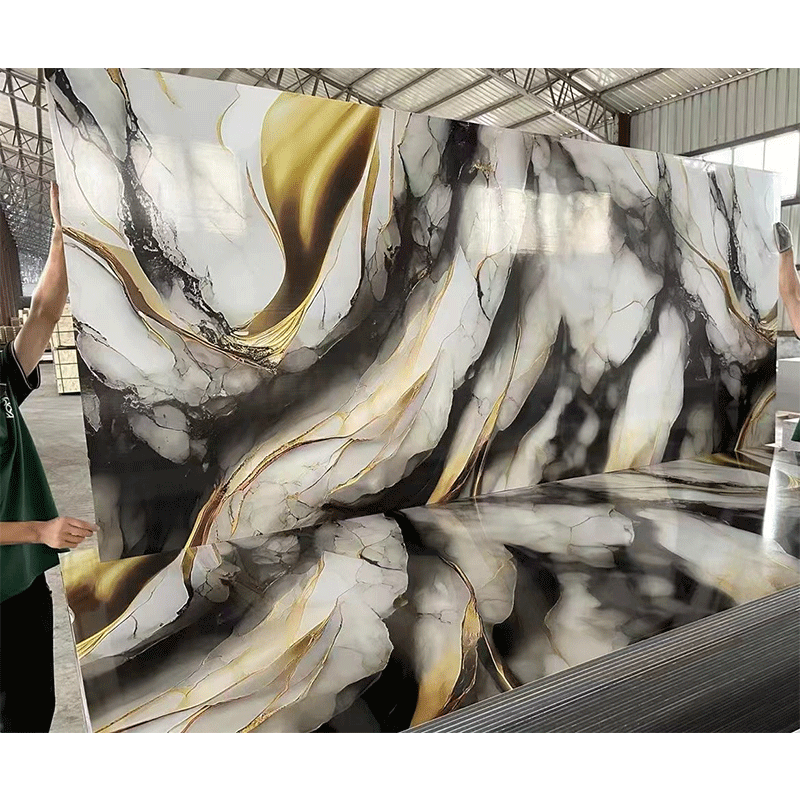
In interior decoration, the hardness of PVC UV boards is essential for ensuring their longevity. For wall panels, a harder board is less likely to get scratched or dented during installation or daily use. In areas such as kitchens and bathrooms, where there may be exposure to water and physical contact, a hard PVC UV board can resist damage better. For example, our Popular Artificial Marble Pvc Sheet with appropriate hardness is a great choice for these applications. It not only provides a beautiful marble - like appearance but also has the durability to withstand the rigors of daily life.
Furniture Manufacturing
When used in furniture manufacturing, the hardness of PVC UV boards affects the overall quality and stability of the furniture. For cabinet doors and drawer fronts, a hard board can maintain its shape and appearance over time. Our Pvc Marble Panel Factory Linyi City offers high - quality PVC UV boards with the right hardness for furniture applications. These boards can be easily cut, shaped, and installed, providing a cost - effective and durable solution for furniture makers.
Industrial Applications
In industrial settings, PVC UV boards need to be able to withstand harsh conditions. Harder boards are more suitable for applications where there is exposure to chemicals, abrasion, or mechanical stress. For example, in the manufacturing of machinery enclosures or protective barriers, a PVC UV board with high hardness can provide reliable protection. Our Flexible Pvc Marble Sheet can also be used in some industrial applications where a certain degree of flexibility is required along with good hardness.
Choosing the Right Hardness for Your Needs
When choosing a PVC UV board, it is important to consider the specific application. If you are using the board for a high - traffic area or an application where it will be exposed to significant physical stress, you should opt for a board with a higher hardness. On the other hand, if flexibility is more important, you may need to balance the hardness with other properties.
As a supplier, we can provide you with detailed information about the hardness of our PVC UV boards and help you select the most suitable product for your project. We have a wide range of products with different hardness levels to meet the diverse needs of our customers.
Conclusion
The hardness of PVC UV boards is a critical property that affects their performance and durability in various applications. By understanding the factors that influence hardness, the measurement methods, and its significance in different scenarios, you can make an informed decision when choosing a PVC UV board.
If you are interested in our PVC UV boards or have any questions about their hardness or other properties, please feel free to contact us. We are always ready to assist you in finding the perfect solution for your project. Our team of experts can provide you with detailed product information, samples, and guidance on installation and use.
References
- ASTM International. (2023). Standard Test Methods for Rubber Property - Durometer Hardness.
- Plastics Europe. (2023). Polyvinyl Chloride (PVC) - Properties and Applications.